This article was originally published in Indigo's Hello 6E in-flight magazine in September 2026.
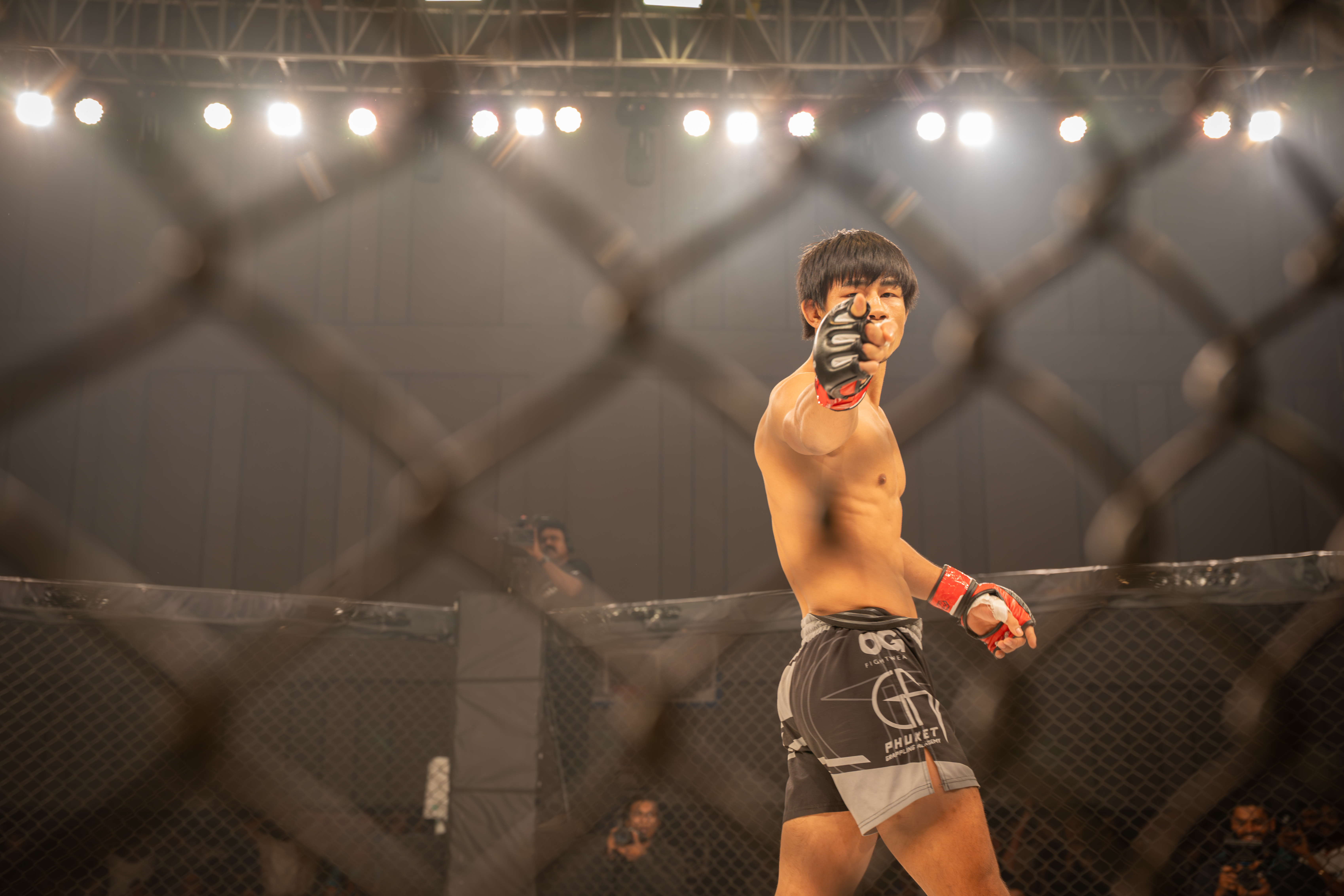
From pioneering gyms in Guwahati to packed academies across the Northeast, a new fighting ecosystem is turning the region’s deep-rooted combat traditions into professional MMA careers
Through his teens, Niranjan Phanjoubam challenged his friends to street fights. Strong and nimble, Phanjoubam relished the duels – but they left his parents dismayed.
But when a mixed martial arts (MMA) academy opened in Assam’s Silchar in 2019 – an hour away from the family home across the state border in Manipur’s Jiribam – Phanjoubam’s hobby took an unexpected turn.
Given his reputation, the owners of the academy, also from Manipur, sought him out. Phanjoubam, though, was insouciant – “I was like, ‘I already fight – why do I have to do this?'”
But he joined nonetheless. And in a month, he realised his flair for street fights could also lead to a real profession.
Less than half a year later, he won his first amateur fight, knocking his opponent out by “spinning my back fist on his neck”.
A couple of medals later, including a bronze in the World Championship in Thailand in 2023, Phanjoubam turned pro, moving to Bengaluru to train.
And the rest is history – even if a tad bloody.
The road from “Manipur’s cage to Bengaluru’s stage”, as he calls it, was often bruising, but not lonely: his fellow travellers comprised an up-and-coming crop of MMA fighters from the sister states of the Northeast.
The popularity of the sport can be gauged by the scores of MMA gyms all over the region: everywhere from the bustling urban centres of Guwahati and Silchar to the quaint hill towns of Aalo and Aizawl.
The infrastructure is not incidental. The region has a long history of combat sports – deeply intertwined with its culture. “What can I say,” says 25-year-old Phanjoubam, now training in Bali, “our ancestors gave us a gift in our genes.”
FIGHTING IS IN THE CULTURE
Northeast India – comprising eight states and home to a patchwork of tribes and ethnicities – has a rich tradition of indigenous martial arts, from Manipur’s Thang-Ta to Nagaland’s Aki Kiti. Many states have their own versions of indigenous wrestling, too, such as Mukna in Manipur, Kene in Nagaland, and Inbuan in Mizoram.
While contemporary MMA combines boxing, wrestling, Brazilian jiu-jitsu, judo, karate and Muay Thai – each requiring distinct technical skills – experts say similarities with indigenous martial arts are unmistakable.
“Traditional martial arts are a precursor to moving into mixed martial arts,” says Delhi-based Andrew Lu, an MMA commentator and podcaster. “The principles remain the same.”
Indeed, the career trajectories and motivations of India’s MMA coaches and fighters suggest as much.
Take Nagaland’s Khriemelie Metha, who, in 2013, moved back home to Dimapur from Mumbai following an injury. Bored, he started “showing some moves” to young boys in his locality. In turn, the boys, who were adept at Kene, or Naga indigenous wrestling, showed him their moves. “And I was like, wow, there are so many similarities to modern martial arts,” says Metha.
It led Metha to launch The Combat Academy in Dimapur, among the first MMA gyms to open in the region in 2014. “Back then no one knew much about MMA,” Metha says, with a laugh, “but everyone wanted to be a street fighter.”
Cut to 2026, MMA has emerged as an unlikely but viable career choice for many youngsters from the region, which has been roiled by years of ethnic insurgencies.
The festering violence and turbulence have meant development and infrastructure have reached Northeastern states like Manipur and Nagaland much later than they did in the rest of the country, leading to high rates of unemployment and a deep sense of neglect.
Kon Jarbin, a 28-year-old MMA fighter based in Arunachal Pradesh’s Itanagar, says he wasn’t quite sure of the job market, despite an engineering degree. That is when he joined Abrasumente Academy, an MMA and fitness gym in Itanagar, and soon “got addicted” to the sense of discipline and purpose it gave. He is now a pro MMA fighter.
Jarbin points to the region’s protein-rich diet, with eggs and meat a staple, which makes many youngsters, particularly from tribal communities, naturally athletic.
MMA fighters and coaches from the region also uniformly point towards the region’s rich historic warrior tradition, the genetic advantage, as Phanjoubam put it.
“Since we have the warrior’s blood, we quickly adapt to MMA,” concurs Roshan Erom, co-founder of The Kanglasha Martial Arts Academy in Silchar, Assam, where Phanjoubam trained.
Lu, the MMA commentator who hails from Shillong, talks about an “inner rage”, a result of years of racism and discrimination the region’s many communities face from the rest of India. “Add to that a sense of disdain from the Indian government. This rage and angst is often channelled into MMA,” he says.
THE GUWAHATI FIGHT CLUB
Most MMA enthusiasts grow up on a steady diet of Bruce Lee and Jackie Chan action films, which often is the first spark.
It was that, and a bit of playful ‘maara maari’ (fisticuffs) with her brother, that got 27-year-old Sonam Zomba to sign up to an MMA gym while she was a commerce student in Guwahati almost eight years ago.
Hailing from the snow-clad mountains of Arunachal Pradesh’s Tawang on the edge of the China border, Zomba thought she would become an entrepreneur, but her years at Bidang in Guwahati – the region’s first professional-standard MMA academy – took her in another direction. Today, she ranks as South Asia’s top female MMA fighter.
Zomba attributes her rapid rise to her coach, Bhabajeet Choudhury, a pioneer in the Northeast’s MMA landscape. A fighter himself, Choudhury quit his stable government job in New Delhi to open Bidang in 2013, which would sow the seeds for the region’s vibrant MMA culture.
It took a decade to come to fruition, but Choudhury “always knew that young people from the Northeast had a lot of talent”. “But there was no one to give them guidance or a platform,” he says. Gyms like Bidang went on to become launchpads for many MMA fighters. While aspiring professional fighters still travel to Mumbai and Bengaluru for advanced training, their foundational coaching is now available in the Northeast itself — something that was not possible earlier.
The growth has been rapid. Today the Northeast has at least seven professional MMA gyms in Arunachal Pradesh, four in Assam, five in Mizoram, three in Manipur, two in Meghalaya, and one in Tripura. Top international fighters also regularly visit the region to train young talent.
“And the gyms are all packed,” says Jarbin. “This was unthinkable a decade ago.”
FROM PASSION TO PROFESSION
The money also started pouring in, courtesy the region’s first promotion, “Aturto”, launched by Higio Taarak, a former Brazilian jiu-jitsu champ from Arunachal Pradesh’s Itanagar.
Like Chaudhury, Taarak always felt the region had no lack of talent. “But these boys and girls had to travel all the way to Delhi, Mumbai or Bengaluru to fight, and at their own expense,” he says. So in 2019, he opened Abrasumente Academy, an MMA gym in Itanagar, and later launched Aturto, the MMA promotion, in 2023.
“Our main objective was to build an infrastructure for our fighters to fight without spending a single penny,” Taarak says. Taarak’s Aturto, which translates to ‘Be Strong’ in the Nyishi language, is only second to Bollywood star Tiger Shroff’s premiere Matrix Fight Night in terms of viewership. In addition to Aturto, there are other local promotions too: Bidang Fighting Championship (BFC) and Shillong Cage Fighting Championship.
THE NEXT ROUND
The robust support system has resulted in many rags-to-riches MMA success stories from the region. Nazareth Lalthazuala from Mizoram, an amateur champion who sold vegetables and drove a taxi to make ends meet, nearly walked away from the sport, unable to afford training. But then came Joseph Lalchhuanawma Rokhum, an MMA enthusiast, who had set up a platform to support Mizo fighters.
“The life I’m living now is beyond what I imagined,” Lalthazuala, who trains at Guwahati’s Dojang MMA & Fitness Studio, says. “And that’s all because of my coaches.” Analysts say the growing network of such support systems, coupled with the innate flair for the martial arts, means MMA will only become bigger in the Northeast.
As fighter Phanjoubam puts it: “Martial arts aren’t a hobby where I come from; they are a way of life.”